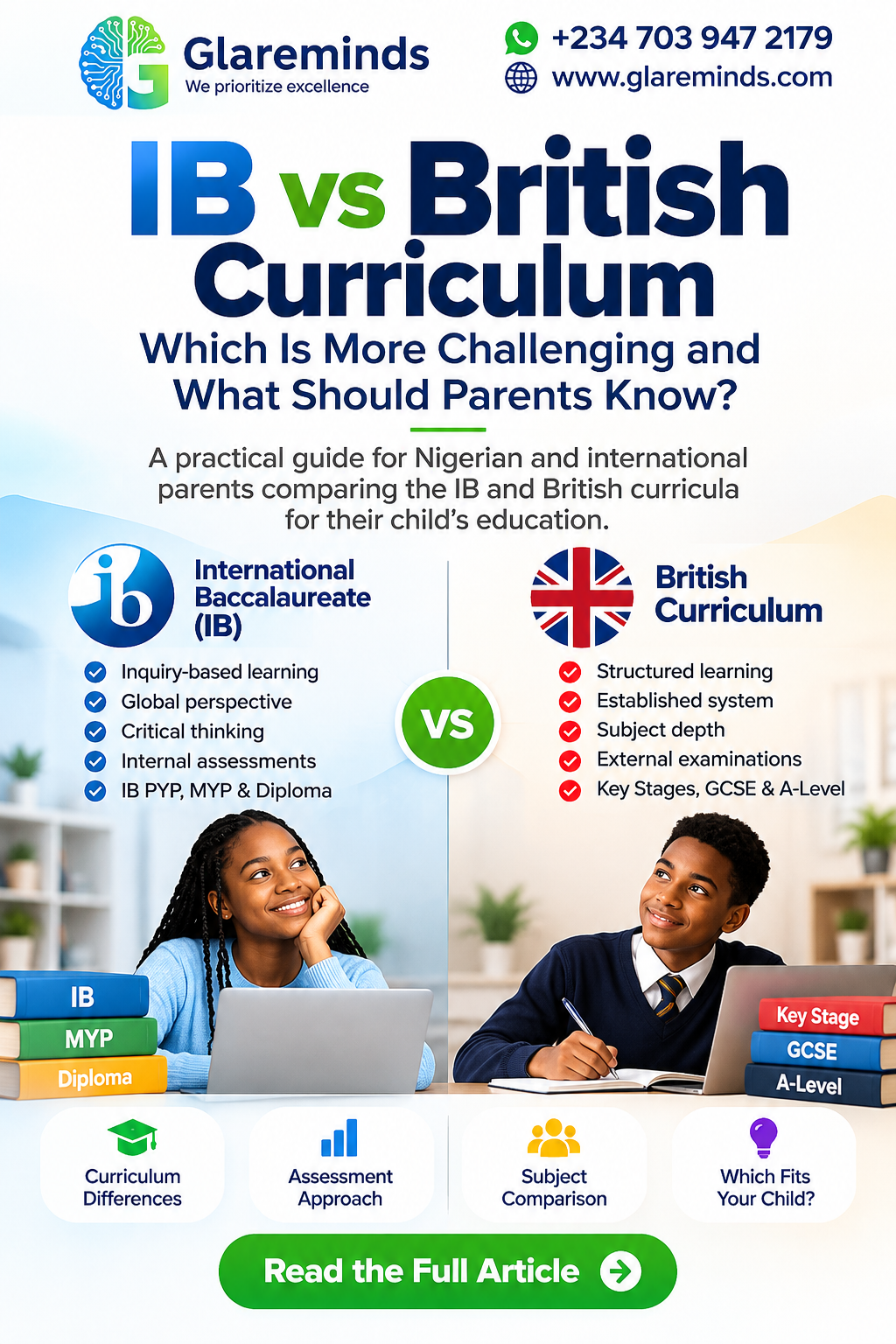
For parents choosing an international education for their child, one question comes up frequently:
What is the difference between the IB and British curriculum, and which one is more challenging?
Both are internationally recognized educational pathways, but they approach learning, assessment and student development differently.
For Nigerian parents and African families living in the UK, Canada, UAE and other countries, understanding these differences can be particularly important when choosing a school, changing curricula or arranging private tutoring.
At Glareminds, we believe the more useful question is not simply, “Which curriculum is harder?”
Parents should also ask:
Which learning approach is more suitable for my child?
Let's examine the differences.
What Is the IB Curriculum?
The International Baccalaureate (IB) provides programmes covering different stages of a student's education.
These include the Primary Years Programme (PYP), Middle Years Programme (MYP), Diploma Programme (DP) and Career-related Programme (CP).
One distinguishing feature of IB education is its emphasis on inquiry, critical thinking, communication, research and applying knowledge.
Rather than focusing entirely on whether a student remembers information, IB learning can require students to investigate ideas, make connections and explain their reasoning.
For some learners, this approach is exciting.
For others, particularly students accustomed to highly structured instruction, adapting can take time.
What Is the British Curriculum?
The term British curriculum generally refers to educational pathways based on the English system, although parents should check exactly which programme a particular school follows.
Students typically progress through stages of primary and secondary education, with qualifications such as GCSE/IGCSE and A-Level becoming particularly important during secondary education.
British education generally provides clear subject progression and recognizable assessment milestones.
This structure is one reason it is widely used by international schools around the world.
IB vs British Curriculum: The Main Difference
The difference isn't simply that one curriculum contains harder Mathematics or more difficult Science.
A significant difference lies in how students are expected to learn and demonstrate understanding.
IB education places substantial emphasis on inquiry, interdisciplinary thinking, research and applying knowledge.
British programmes tend to provide a more clearly defined subject and qualification structure, particularly as students approach GCSE/IGCSE and A-Level.
Both can be academically demanding.
They simply create different types of demands.
Which Is More Challenging?
There isn't a universal answer.
IB may feel more challenging for a student who struggles with independent inquiry, extended projects, research, reflection or managing several academic demands simultaneously.
Meanwhile, GCSE, IGCSE or A-Level can be demanding because of subject depth, syllabus coverage and examination performance.
A student who thrives in one system might struggle in another.
That is why parents shouldn't select a curriculum simply because someone describes it as easier or harder.
The learner matters.
IB vs GCSE/IGCSE
This comparison needs some care because IB is a family of programmes rather than a single qualification directly equivalent to GCSE.
However, families moving between international schools may encounter IB MYP on one side and GCSE/IGCSE pathways on the other.
MYP encourages students to make connections, investigate concepts and apply knowledge.
GCSE/IGCSE courses become increasingly focused on defined subjects and their assessment requirements.
Neither automatically produces stronger students.
The experience depends on the learner, school, teachers and subjects involved.
IB Diploma vs A-Level
The distinction becomes particularly interesting at the upper-secondary stage.
Students following A-Levels typically specialize in a smaller number of subjects.
The IB Diploma Programme maintains greater breadth across several subject areas while also including additional core requirements.
This can make the IB Diploma attractive to students who enjoy a broad academic programme.
A-Level may appeal to learners who want greater concentration on selected subjects.
Parents should therefore consider their child's academic strengths, interests and future plans.
Mathematics: IB vs British Curriculum
Both systems can offer demanding Mathematics.
The challenge may simply appear differently.
IB Mathematics can place significant emphasis on understanding, reasoning, interpretation and application.
British pathways also require conceptual understanding and increasingly sophisticated problem-solving, particularly at higher levels.
A learner shouldn't therefore assume that moving from one curriculum to another automatically makes Mathematics easier.
Instead, parents should investigate whether there are curriculum transition gaps.
Science: IB vs British Curriculum
Science provides another useful comparison.
Both pathways can develop strong knowledge in Biology, Chemistry and Physics.
IB programmes can place substantial emphasis on inquiry and scientific thinking.
GCSE/IGCSE and A-Level Science generally follow defined subject specifications with clear assessment objectives.
Students moving between the two may therefore need time to adjust not only to different content but also to different ways of demonstrating understanding.
Assessment Differences
Assessment is one of the most important areas parents should investigate.
A learner who performs extremely well in traditional examinations may not necessarily respond identically to a programme involving a broader combination of assessment approaches.
Likewise, a student who produces excellent coursework and projects still needs appropriate preparation for formal assessments where these form part of the programme.
Parents should therefore ask schools exactly how their child's programme is assessed rather than relying on the curriculum name alone.
Which Curriculum Develops Better Critical Thinking?
Both curricula can develop critical thinking when taught effectively.
IB explicitly places considerable emphasis on inquiry and reflection across its educational philosophy.
British programmes increasingly require analysis, evaluation and problem-solving as students progress.
The quality of teaching remains extremely important.
Simply enrolling a child in a particular curriculum doesn't automatically develop critical thinking.
Students need opportunities to actually think, question, explain and solve problems.
Which Curriculum Is Better for University?
Both educational pathways can lead students to universities internationally.
The more important considerations are usually the student's eventual qualifications, subjects, results and the requirements of the institutions and courses to which they intend to apply.
Parents of older students should therefore investigate specific university entry requirements rather than assuming one curriculum is universally preferable.
Moving From British Curriculum to IB
Changing curricula can create temporary learning gaps.
A student moving from a British programme into IB may encounter different expectations around inquiry, research, writing or independent learning.
This doesn't mean the student is academically weak.
They may simply need time and support to adapt.
A diagnostic assessment can help determine whether there are genuine subject gaps or simply unfamiliarity with the new learning approach.
Moving From IB to British Curriculum
The reverse can also happen.
A learner moving into GCSE/IGCSE or another British programme may need to become familiar with specific syllabus expectations and examination styles.
Again, parents should avoid assuming that a curriculum change automatically means starting again academically.
Much of the student's knowledge may transfer.
The challenge is identifying what transfers and what needs additional attention.
Which Curriculum Is Better for Nigerian Students?
There is no single curriculum that is best for every Nigerian learner.
Some students thrive in highly inquiry-driven environments.
Others perform extremely well with structured subject progression and clearly defined examination objectives.
Parents should consider the child's:
- learning style and academic strengths;
- ability to work independently;
- subject interests;
- current learning gaps;
- future university plans;
- school environment;
- ability to manage workload.
The curriculum should serve the learner rather than forcing the learner into a system simply because it is internationally recognized.
Why Private Tutoring Can Help With Either Curriculum
Whether a learner follows IB or the British curriculum, difficulties can occur.
A student may struggle with Mathematics, Science, English or a particular academic skill.
One-on-one tutoring can help identify exactly where the difficulty begins.
For example, the apparent problem may be algebra.
A diagnostic session could reveal that the actual problem is fractions.
Another student may appear weak in Science when the real difficulty is interpreting examination questions.
Personalized tutoring allows these differences to be addressed individually.
IB and British Curriculum Tutoring at Glareminds
At Glareminds, our tutoring philosophy focuses on understanding the learner before recommending academic support.
Our approach includes:
Academic diagnosis → identifying learning gaps → personalized learning plan → one-on-one tutoring → progress monitoring → parent feedback.
Support can cover Mathematics, English, Science, Computer Science and other academic areas depending on the learner's curriculum, level and tutor availability.
For Nigerian and African families living abroad, online tutoring also makes it possible to receive personalized academic support regardless of location.
Frequently Asked Questions
Is IB harder than the British curriculum?
Not necessarily. The programmes create different academic demands. IB may be particularly demanding in areas such as inquiry, breadth, research and independent learning, while GCSE/IGCSE and A-Level programmes can involve substantial subject depth and examination requirements.
Is IB better than GCSE?
They aren't directly interchangeable programmes. Parents should compare the specific educational stage, subjects, assessment approach and needs of their child rather than treating one as universally superior.
Is IB Diploma harder than A-Level?
Both can be academically demanding in different ways. IB Diploma maintains considerable subject breadth, while A-Level students generally specialize more heavily in fewer subjects.
Can a student move from British curriculum to IB?
Yes, but the student may need time to adapt to differences in learning and assessment. Identifying curriculum gaps early can make the transition easier.
Can a student move from IB to British curriculum?
Yes. Academic knowledge can transfer, although learners may need support becoming familiar with different syllabus and assessment expectations.
Can Glareminds support IB and British curriculum students?
Glareminds provides personalized online academic tutoring across international curricula, subject to the learner's specific programme, level and tutor availability.
Need Help Choosing or Transitioning Between Curricula?
If your child is following the IB or British curriculum and you're concerned about Mathematics, English, Science or their overall academic progress, don't wait for learning gaps to become larger.
Glareminds provides personalized one-on-one online tutoring designed around each learner's academic needs.
WhatsApp/Call: +234 703 947 2179
Website: www.glareminds.com
Glareminds — personalized learning for stronger understanding, confidence and academic progress.