Why do some children struggle with Mathematics even when they attend excellent schools, complete their homework and receive extra lessons?
This is a question many parents ask when their child's school results do not reflect the effort being invested in their education.
Imagine paying for a good school, buying textbooks, monitoring homework and ensuring your child attends classes regularly, only to discover another disappointing Mathematics test result.
Your child may even say, "I understand everything."
But when asked to solve a question independently, they become confused.
For parents in Nigeria, the United Kingdom, Canada, Australia and the United States, this situation can be frustrating.
However, poor Mathematics performance does not automatically mean a child lacks intelligence or academic potential.
Sometimes, the problem lies in learning gaps, teaching methods, insufficient practice or a lack of confidence.
Understanding the real cause is the first step towards helping your child improve.
1. Your Child May Have Learning Gaps From Previous School Years
Mathematics is a progressive subject. New concepts frequently depend on earlier knowledge.
A Year 8 student struggling with algebra may actually have difficulties with fractions, negative numbers or multiplication.
For example, consider:
3x + 5 = 20
To solve this equation, a learner needs to understand subtraction, division and the meaning of an unknown variable.
If those foundations are weak, algebra becomes difficult.
What parents can do: Rather than repeatedly asking your child to study harder, identify the earlier concepts they have not mastered.
A personalised Mathematics assessment can help determine where those gaps begin.
2. Your Child Understands Examples but Cannot Solve New Questions
Some students can follow a teacher's explanation perfectly.
However, when the numbers change or the question is presented as a word problem, they struggle.
This happens when students become familiar with a particular solution method without fully understanding why it works.
For instance, a child may solve:
5 × 8 = 40
But struggle with:
"A school has eight classrooms, each containing five tables. How many tables are there altogether?"
The difficulty may involve interpreting language and translating a real-life situation into a mathematical expression.
What parents can do: Encourage your child to explain how they arrived at an answer. Introduce different question formats instead of repeating identical exercises.
3. Your Child May Be Afraid to Ask Questions in Class
Not every child who remains quiet in class understands the lesson.
Some students avoid asking questions because they fear embarrassment or believe their classmates will judge them.
Others may think they are the only ones who do not understand.
As lessons progress, unanswered questions can develop into significant learning gaps.
What parents can do: Create an environment where your child feels comfortable admitting confusion.
Ask questions such as:
- "Which part of today's Maths lesson was difficult?"
- "Can you teach me something you learnt today?"
- "Was there any question you wanted to ask your teacher?"
These conversations can reveal difficulties before they affect examination performance.
4. Your Child May Be Memorising Mathematics Instead of Understanding It
Memorisation has a place in Mathematics, but memorising procedures without understanding concepts can limit progress.
A learner may remember a formula yet struggle to decide when to apply it.
For example, knowing the formula for the area of a triangle is different from understanding why the formula works.
What parents can do: Encourage reasoning, visual demonstrations and practical examples.
Effective Mathematics tutoring should teach students how to think, not simply what answers to write.
5. Your Child May Need a Different Teaching Approach
Children do not always respond equally well to the same explanation.
One learner may understand fractions through diagrams. Another may benefit from practical examples involving money or measurements.
In a busy classroom, teachers must balance the needs of many students.
A learner who needs more time may therefore benefit from additional individual instruction.
What parents can do: Look for a tutor who adapts explanations to your child's current understanding rather than simply repeating classroom lessons.
6. Your Child May Have Developed Mathematics Anxiety
Some children become nervous whenever they encounter a Mathematics test.
Even when they have studied, anxiety may interfere with concentration and working memory.
Signs can include avoiding Mathematics homework, becoming upset during practice or repeatedly saying, "I am not good at Maths."
What parents can do: Avoid describing your child as naturally weak in Mathematics.
Recognise effort, encourage manageable challenges and celebrate genuine improvement.
If anxiety is persistent or significantly affects everyday life, consider discussing it with your child's teacher or an appropriate educational professional.
7. Your Child May Not Be Practising Independently
Watching a teacher solve questions is not the same as solving them independently.
Some students rely heavily on worked examples, calculators or assistance from adults.
When they face examination questions without help, they struggle to recall the necessary steps.
What parents can do: Introduce short, regular independent practice sessions.
After each lesson, ask your child to complete a few questions without assistance, then review mistakes constructively.
8. Your Child May Be Studying a Curriculum That Requires Different Skills
Children attending international schools or relocating between countries may encounter unfamiliar curriculum expectations.
A learner moving from Nigeria to Canada, for example, may need support adjusting to the sequence of topics and assessment methods used in their province.
Similarly, students following British, Cambridge, American or Australian curricula may encounter different terminology, question styles and learning objectives.
This does not necessarily mean one curriculum is harder than another.
It means that teaching must match what the learner is expected to know.
What parents can do: Ensure that any additional tutor understands your child's specific curriculum, school year and assessment requirements.
9. Nobody May Be Tracking Your Child's Actual Progress
A child can attend extra lessons for several months without making meaningful progress if nobody measures what they are learning.
Completing a syllabus is not the same as mastering it.
Parents should be able to understand:
- Which topics their child has mastered
- Which concepts still require attention
- Whether independent problem-solving is improving
- What the next learning goals should be
What parents can do: Request periodic academic feedback and evidence of improvement through assignments, assessments and independent exercises.
How Can Parents Tell Whether Their Child Needs a Private Maths Tutor?
Not every disappointing test result requires private tutoring.
Sometimes, reviewing homework, speaking with the schoolteacher and establishing a consistent study routine may be enough.
However, additional support may be helpful when a learner repeatedly struggles with foundational topics, avoids Mathematics, cannot complete age-appropriate questions independently or continues falling behind despite reasonable classroom support.
The goal should not simply be to hire a tutor.
The goal should be to understand the problem and choose the most appropriate intervention.
How Glareminds Helps Students Who Struggle With Mathematics
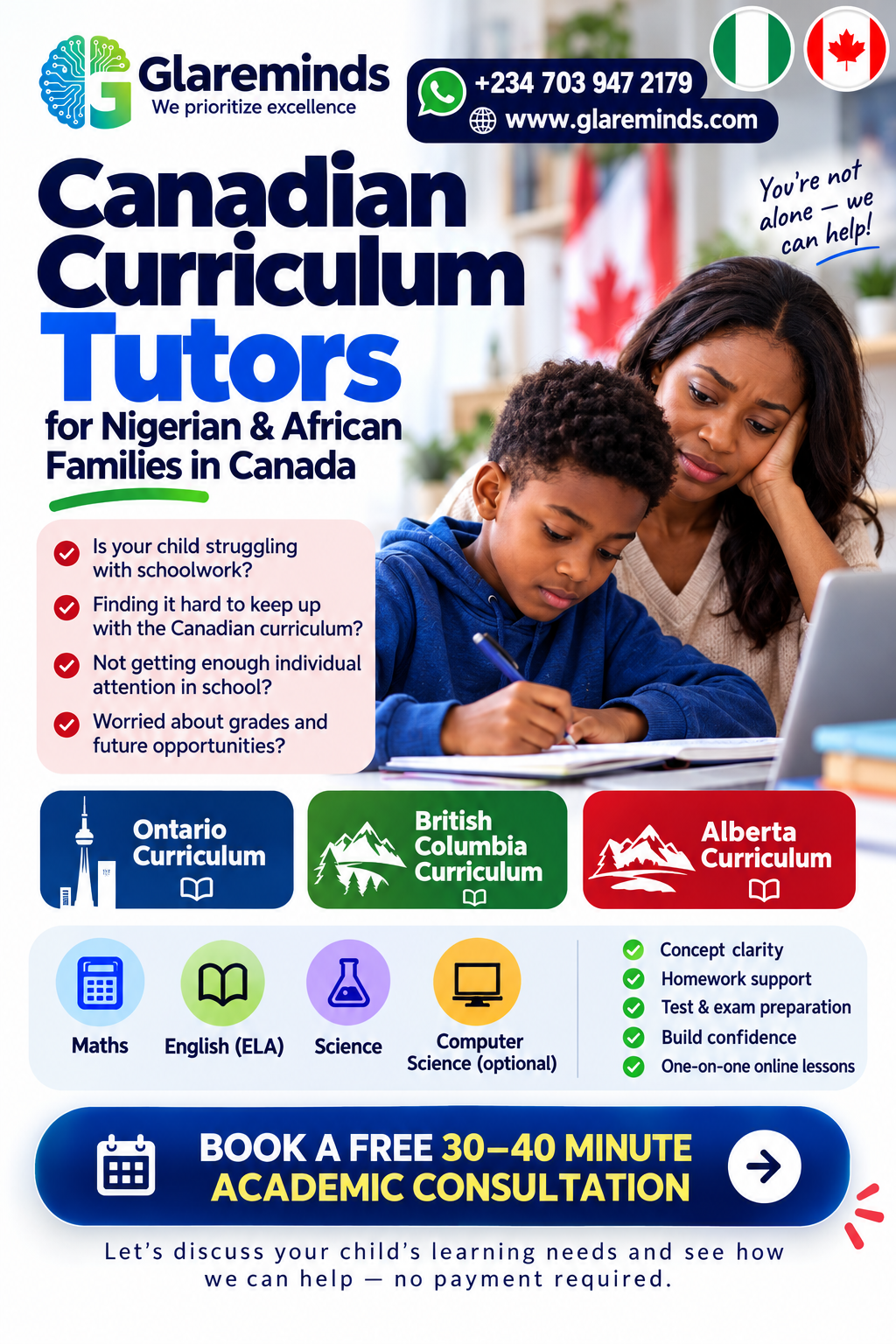
At Glareminds, we provide personalised one-on-one online Mathematics tutoring for learners following Nigerian and international curricula.
Our approach begins with understanding the individual learner rather than assuming that every student requires the same lesson.
We support students studying:
- Nigerian Curriculum — Primary and Secondary Mathematics
- British Curriculum — Key Stages, GCSE and IGCSE
- Cambridge Mathematics
- Canadian Curriculum — including Ontario and British Columbia
- American Curriculum — K–12 Mathematics and SAT preparation
- Australian Curriculum — Primary and Secondary Mathematics
Our online Mathematics lessons emphasise live explanations, step-by-step problem-solving, guided practice and independent exercises.
We also provide academic feedback so parents can better understand their child's progress.
Start With a Free Academic Consultation
Before committing to a tutoring programme, it is important to understand your child's current academic needs.
Glareminds offers an initial 30–40-minute free consultation and academic diagnostic session to help identify areas where additional support may be useful.
This allows parents to discuss their child's difficulties, understand possible learning gaps and explore suitable tutoring options.
Whether your child is in Lagos, Abuja, London, Manchester, Toronto, Vancouver, Melbourne or another location, our live online tutoring model makes personalised academic support accessible from home.
Your child does not necessarily need more hours of studying. They may need a better understanding of what has been holding them back.
Book a Free Consultation With Glareminds
Website: https://glareminds.com/
WhatsApp: +234 703 947 2179
Glareminds — We Prioritise Excellence.
Frequently Asked Questions
Why is my child struggling with Maths despite attending a good school?
Possible reasons include foundational learning gaps, limited independent practice, Mathematics anxiety, unfamiliar question formats or teaching approaches that do not suit the learner's current needs.
Can a private Maths tutor help a struggling student?
A qualified tutor may help by identifying learning gaps, providing targeted explanations, assigning appropriate practice and monitoring improvement. Results depend on the learner's needs, teaching quality and consistency.
How often should a child receive private Mathematics lessons?
There is no single schedule that works for every learner. The appropriate frequency depends on the child's current ability, academic goals, school workload and available time.
Can online Mathematics tutoring work for primary school children?
Yes. Live online tutoring can be effective when lessons are interactive, age-appropriate and supported by suitable writing tools, practice exercises and adult assistance where necessary.
Does Glareminds provide Maths tutoring for international curricula?
Yes. Glareminds provides online Mathematics support for learners following Nigerian, British, Canadian, American, Australian and Cambridge curricula.