Your child used to finish Maths homework quickly. Now letters appear in almost every question, the teacher is discussing graphs, and your child says, “I don’t know where to start.”
If your child attends an American curriculum school in Nigeria, you may wonder whether they are ready for Algebra—or whether a few earlier gaps are making new topics feel harder than they should.
A low mark on one test cannot answer that question. Neither can asking, “Are you good at Maths?”
A better approach is to look at how your child handles numbers, relationships, equations and unfamiliar questions. When you know where they become stuck, you can give them support that fits.
First, Check Your Child’s Actual Maths Course
Ask the school what your child is studying now and what they will study next. “American curriculum” does not mean that every school in Lagos, Abuja or elsewhere in Nigeria uses identical textbooks or teaches Algebra 1 in the same grade.
Request the current topics and ask whether your child is following Grade 8 Maths, an accelerated course, Algebra 1 or another school pathway. Also ask the teacher which skills a learner should bring into the next unit.
For context, widely used US Grade 8 Maths standards include work with equations, proportional relationships, lines and functions. That makes earlier number and reasoning skills valuable, but your child’s schoolwork remains the best starting point for an individual plan.
Why Algebra Can Expose an Earlier Gap
Suppose your child sees:
2(x+3)=182(x+3)=18
They may understand that xx stands for an unknown number. But to solve the equation, they also need to work accurately with operations, understand what the brackets mean and keep both sides equal.
If they struggle, the problem might be the new algebraic idea. It might also be an earlier difficulty with division, negative numbers or the order of operations.
The aim is to find the first step they do not understand. That is more useful than repeating the entire chapter or telling them to practise harder.
A Five-Question Check You Can Try at Home
Give your child a quiet moment to attempt these questions independently. Ask them to show their working and explain their choices. Do not tell them the topic before each question.
These examples are illustrative questions, not an official assessment or a complete list of Grade 8 expectations.
Question 1: Negative numbers
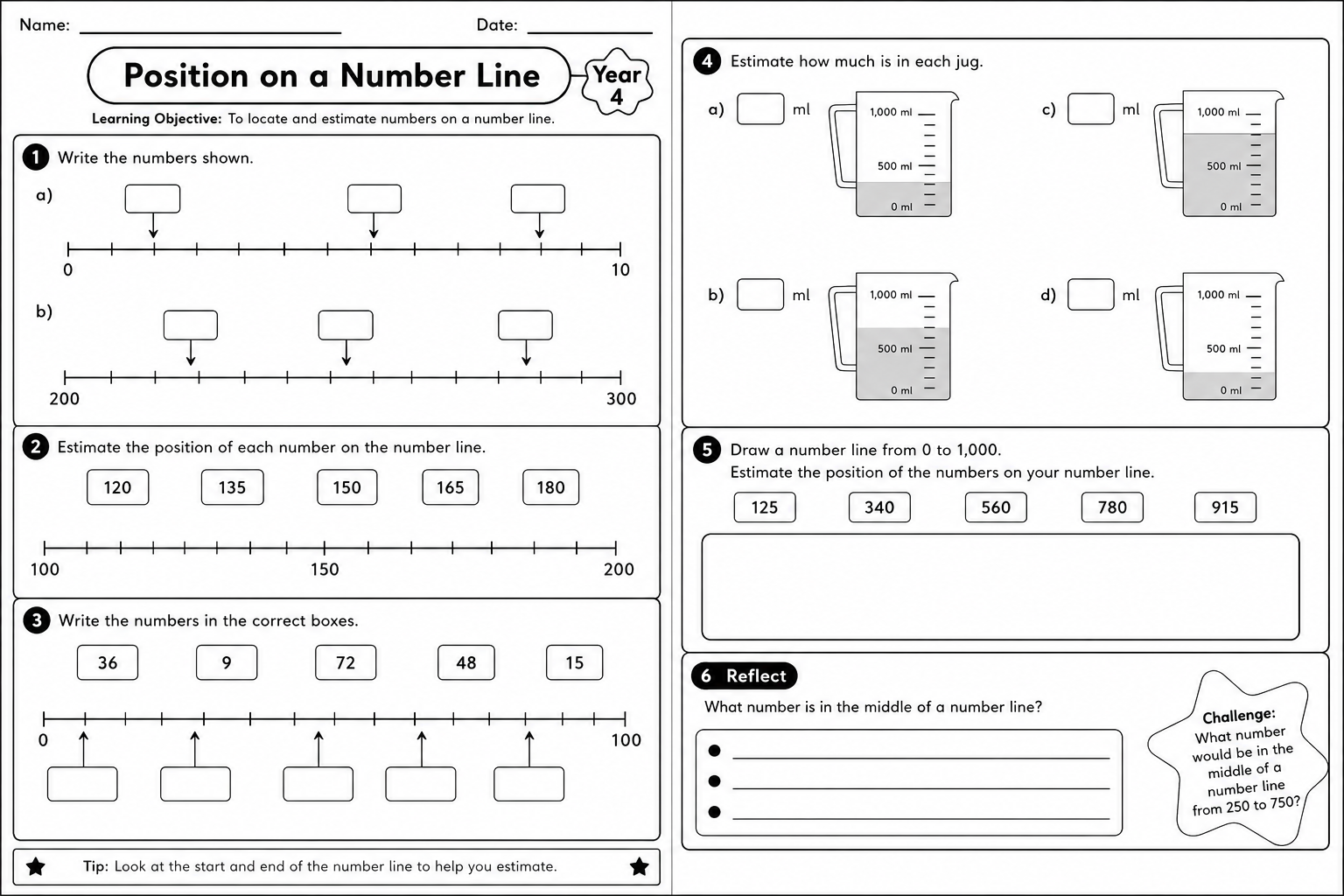
Calculate −4+9-4+9. Explain your answer using a number line if you can.
Answer: 5.
Starting at −4-4 and moving nine places to the right lands at 5.
If your child gets −13-13, ask them to show the movement on a number line. The difficulty may be understanding what adding a positive number does, rather than an inability to work with algebra.
Question 2: Fractions
Calculate 34÷12\frac{3}{4}\div\frac{1}{2}. What does your answer mean?
Answer: 1121\frac{1}{2}, or 1.5.
The question asks how many halves fit into three quarters. One half fits, with one quarter left; one quarter is half of a half.
A child may remember a fraction-division rule and get the answer. Ask them whether the result makes sense. Since 12\frac{1}{2} fits into 34\frac{3}{4} more than once, an answer smaller than one should prompt a check.
Question 3: An equation
Solve 2(x+3)=182(x+3)=18. Check your answer.
Answer: x=6x=6.
Divide both sides by 2 to get x+3=9x+3=9, then subtract 3. Check by substituting 6:
2(6+3)=2(9)=182(6+3)=2(9)=18
A child who gets the answer by guessing may still need a reliable method for equations with less convenient solutions. A child who writes 2x+3=182x+3=18 may need help understanding how multiplication applies to everything inside the brackets.
Question 4: A pattern and a rule
A table shows these pairs:
x:0, 1, 2, 3x: 0,\ 1,\ 2,\ 3
y:3, 5, 7, 9y: 3,\ 5,\ 7,\ 9
Describe the rule connecting xx and yy. What would yy be when x=10x=10?
Answer: y=2x+3y=2x+3, so when x=10x=10, y=23y=23.
The yy-value rises by two whenever xx rises by one. When x=0x=0, y=3y=3, which accounts for the extra three.
A child may correctly continue the list to find 23 but struggle to express a rule. That is a useful distinction: they can spot a pattern, but may need practice representing it algebraically.
Question 5: A real situation
A print shop charges ₦800 to set up an order and ₦1,200 for each notebook printed. What will it cost to print four notebooks? Write a rule for the cost of nn notebooks.
Answer: Four notebooks cost ₦800+4(₦1,200)=₦5,600₦800+4(₦1,200)=₦5,600. A rule is:
C=800+1200nC=800+1200n
where CC is the total cost in naira and nn is the number of notebooks.
Ask your child which charge happens once and which charge increases with each notebook. If they multiply the ₦800 setup fee by four, the arithmetic may be correct but their interpretation of the situation is not.
What Do Your Child’s Answers Suggest?
Do not total the five answers and call it an “algebra readiness score.” Use the working to look for a pattern.
What you noticeWhat to investigateNegative numbers cause mistakes inside and outside equations.Number-line understanding and operations with signed numbers.Fraction rules are memorised but answers are not checked.The meaning of fraction operations and estimation.Your child can guess an equation’s answer but cannot show a method.Inverse operations, equality and checking by substitution.They extend a pattern but cannot write a rule.How changing quantities are represented with variables.They can calculate once told what to do but cannot model a story.Reading the quantities and deciding how they relate.
One missed question does not prove a lasting problem. Compare it with recent schoolwork and ask the teacher what they see in class.
What Does a Stronger Algebra Foundation Look Like?
A learner with a developing foundation does more than follow an example. They can explain what a variable represents, show why a step keeps an equation balanced, connect a table to a rule and check whether an answer fits the original question.
They may still make errors. What matters is whether they can understand feedback and use the idea on a new question, rather than only repeat the corrected one.
If your child solves 2(x+3)=182(x+3)=18 with help, try a different equation later. If they can choose a sensible first step and check their answer independently, you have better evidence of progress.
How to Help Without Turning Home Into Another Classroom
Choose one priority from your child’s work. If negative-number mistakes keep appearing, start there before attempting a long list of algebra questions.
You can help by asking:
- “What does this number or letter represent?”
- “Why did you choose that step?”
- “Will the same change need to happen on both sides?”
- “Does your answer fit the original question?”
- “Can you solve another question like this without my hint?”
Let your child think before you demonstrate. If you always choose the first step for them, it becomes difficult to see what they can do independently.
Share two or three marked examples with their teacher. Ask which foundation to work on first and how it connects to the current unit.
When Would an Algebra Tutor Help?
Individual support may help if your child repeatedly needs someone to start every question, becomes anxious about Maths, or makes the same foundational error across several topics.
A tutor should look at the child’s actual schoolwork and identify whether the main gap lies in number skills, equation solving, representing relationships or interpreting questions.
A useful goal could be:
“Solve one-variable equations, explain each step and check the solution independently.”
Another child might need a different goal, such as representing a real situation with a table and a rule. The plan should follow the learner’s evidence, not a generic “Grade 8 Algebra” worksheet pack.
American Curriculum Maths Support in Nigeria
Glareminds provides one-to-one online Maths support for children studying American and other international curricula in Nigeria. We review current work, identify where the learner becomes stuck and build lessons around the skills they need for their school programme.
If your Grade 8 child attends an American curriculum school in Lagos, Abuja, Port Harcourt or elsewhere in Nigeria and is finding Algebra difficult, book an academic consultation with Glareminds. Bring a recent assignment or marked test so we can begin with their actual questions.
Book an academic consultation with Glareminds
Frequently Asked Questions
Does every American curriculum student take Algebra 1 in Grade 8?
No. Course placement and sequence vary by school. Ask your child’s school which course they are taking and what comes next.
My child can calculate but cannot answer algebra word problems. What should we check?
Ask them to identify what the unknown represents, which amount stays fixed and which amount changes. Their difficulty may be representing the situation rather than carrying out the calculation.
Should my child memorise equation-solving steps?
A method is useful, but they should understand why each step preserves equality and be able to check the result in the original equation.
How can I tell whether tutoring is helping?
Use a new question from a topic your child has studied. Check whether they can choose a method, explain it and verify the answer with fewer hints.